

The dark side of Dark Tourism
How do we remember places with difficult histories?

“Bosnia is not a war-torn country, I don’t want people to think about us like that.”
I’m riding in the car with Bosnian Man. He kindly offered to take me to the bus station across town. Of course I know his name, we have become good friends over the last few weeks. I had been volunteering at a hostel in Sarajevo on my journey across the Balkans: earning by keep by pouring beers and changing bedsheets, that kind of thing.
Bosnian Man had been explaining to me how frustrated he gets when people come to Sarajevo with a well-meaning mentality of sympathy that manifests as a somber aura of pity. I had heard it myself often from the people staying at the hostel. After pouring them a beer or a shot of welcome rakia, I got hit with the same response:
“Oh, Sarajevo, it’s just so sad.”
I look out the window, my eyes tracing the orange-roofed houses spilling down the mountain side, the horizon dotted by minarets peeking out past the rooflines. The late afternoon sunlight lit the ravine up in a burst of copper and amber. How one could feel sad looking at this sun-soaked scene, I could not comprehend.
We drive along the curving road, past the sign that marks where we cross into the Republika Srpska—one of those strange grey areas in international law created after the peace agreement was signed in 1995. An autonomous Serbian enclave situated within Bosnia, it is one of the many reminders of how the Balkans remain fractured across ethnic and religious lines.
The sign reads:
“Republika Srpska: Home of the Serbs expelled from Sarajevo”
“Were they actually?” I ask.
BM: “Were they what?”
“Expelled from Sarajevo during the siege? I mean did the government kick them out? Or did they feel the need to move when the Serbs began their assault on the city?”
BM exhaled slowly through his nose, eyes focused on the road ahead. His hands shifted on the steering wheel.
“Well everyone has their stories, don’t they? The narratives that they tell of a place. It’s not that simple, it never is. I mean even when you enter on the Bosnian side, it says “Welcome to Sarajevo, the city under siege for 1,425 days.” That’s not the whole truth. It’s what we choose to remember, what we commemorate with our signs, museums, but it only tells a single narrative.”
“Bosniaks, Serbs, Croats, they were all here in Sarajevo during the war. Sarajevo was their home. We tend to forget that they are brothers, that there is no Bosniak in Sarajevo that isn’t connected to a Serb or Croat, that isn’t related in one way or another.”
We drive past a dilapidated building covered in peeling pink paint, riddled with bullet holes. Many of the buildings in Sarajevo still carry the scars of war: a constant reminder of what happened in a not-so distant past.
“Half of my family, they’re Serbs. Does that mean I hate them? Is there something irredeemably different between me and them? They’re each other’s family, neighbors. The differences, well, that’s all political.”
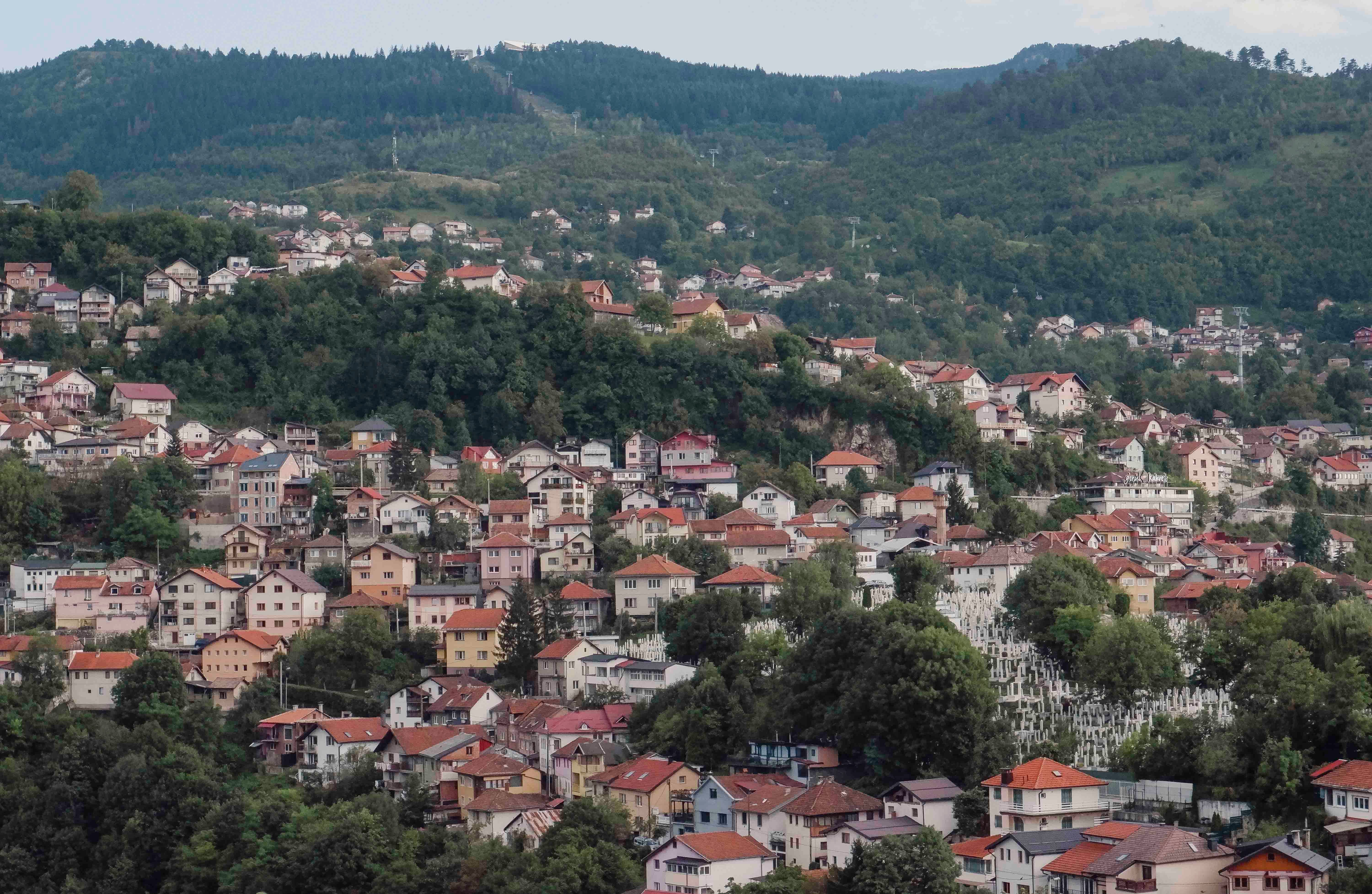
In the breakup of the former Yugoslavia, Bosnia experienced terrible violence and unimaginable horror at the hands of the Serbian military led by president Slobodan Milošević. Many Bosniaks, or Bosnian Muslims, were expelled from their hometowns in a systematic process of ethnic cleansing. The United Nations declared that the attack on ethnic Bosnians constituted genocide, evidenced by the 1995 massacre at Srebrenica. During the nearly four-year war, the city of Sarajevo was the site of a prolonged military blockade an siege that left thousands dead.
DARK TOURISM AND MEMORY
Throughout Bosnia’s capital of Sarajevo, the war and genocide are memorialized through the city’s tourist attractions. The city is home to countless beautiful museums honoring the tragedy of the conflict, the possibilities are endless to pay homage to the suffering of Bosnians during the war and siege. On Trip Advisor, five out of the top 10 things to do in the city relate to the war.
These experiences are examples of Dark Tourism, or the act of visiting places associated with tragedy, suffering, and death. While there are many reasons why a visitor might choose to visit a “dark” tourist location, it is usually to learn about or pay homage to some tragedy.
In many ways, Dark Tourism is a necessary experience to honor and remember the horrors of the past. It can be a positive way to connect people to lived histories of different parts of the world. For many privileged folk around the world, the reality of war and genocide is abstract; it is only through visiting Dark Tourism sites and memorials can they begin to feel the weight of this trauma.
THE HAUNTING OF DARK TOURISM
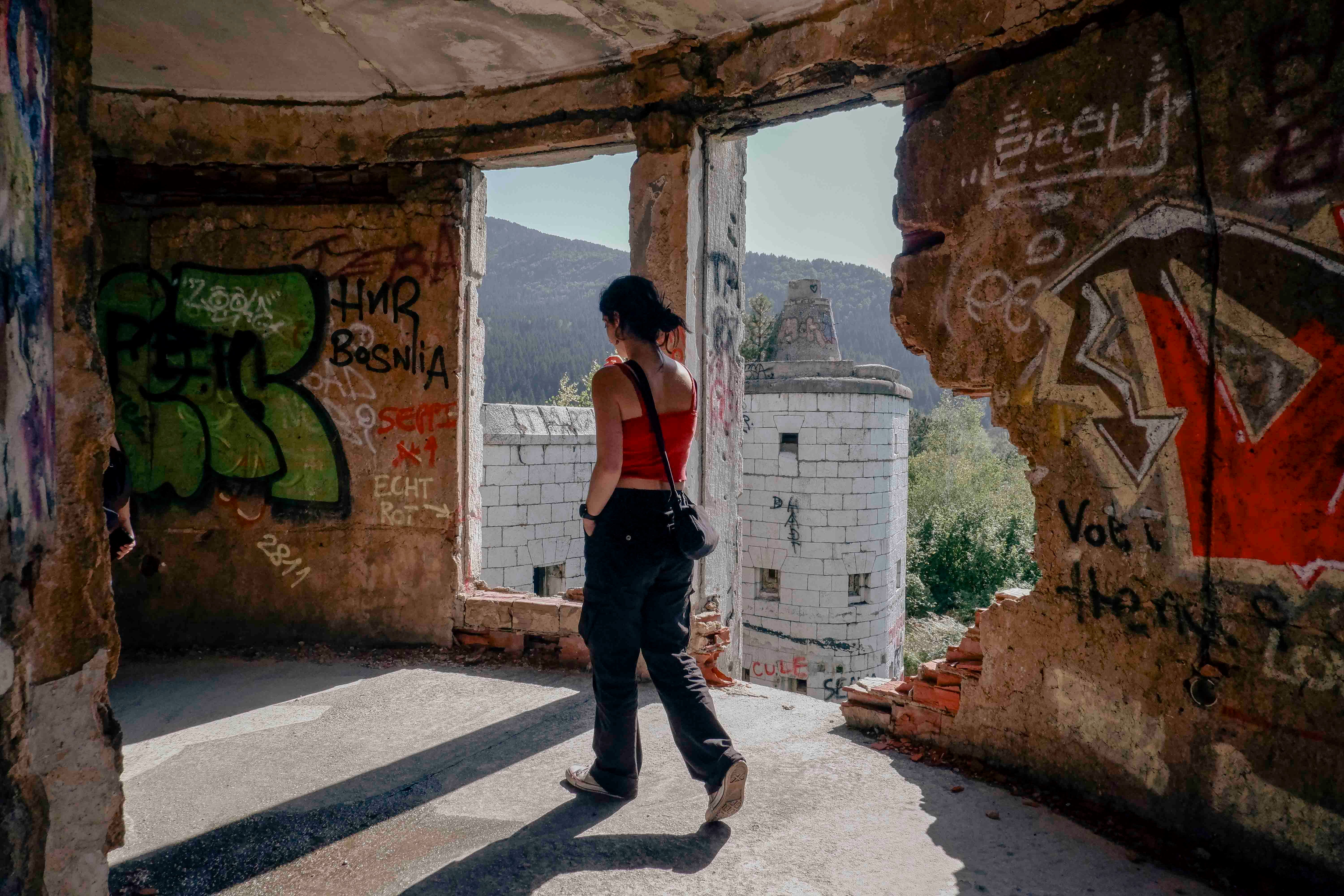
Visiting Dark Tourism sites is often an emotional, heavy experience. Seeing images of tragic events or reading about the suffering of victims often leaves visitors with a gut-wrenching somber feeling that lingers long after their departure. These emotions hold enormous power in shaping our memory of a location.
While these highly emotional, somber experiences help us connect to a moment in time, the danger lies when this becomes our singular or overwhelming experience of a place.
Many people quickly passing through Sarajevo will only remember the haunting photographs of the genocide museum, or the somber expanse of white headstones marking victims of the war. Their memory of the city will be completely shaped by these emotional and dark experiences—to them, Sarajevo will only ever just be “sad”.
In their eyes, Bosnia and Herzegovina will only ever be a “war-torn country”.
I wonder how a place can be consumed by its own Dark Tourism. How in the act of honoring their they can be held back by remembering a difficult and violent past. How re-remembering, re-living, and re-educating visitors forces locals to re-live painful trauma and holds back a community from being able to heal and move on.
DANGER OF A SINGLE STORY
In her infamous Ted Talk “The Danger of a Single Story”, author and storyteller Chimamanda Ngozi Adichie warns against viewing places and people as monoliths. As a Nigerian woman, she speaks of her difficulties encountering people abroad who viewed “Africa” as a single story of poverty and strife. In her talk, she urges us to challenge that singular way of thinking and to seek different voices to broaden our perspectives.
Travel is meant to expand our understanding of the world and allow us to contend with multiple ideas and perspectives. It is supposed to push us to meet and learn from new people and challenge our own world views. That means coming to terms with complicated and difficult histories and letting people and places be more than one thing in our minds.
It also means challenging what we might encounter at first glance. Yes, many buildings in Sarajevo still carry bullet holes and the scars of war, but buildings are just buildings. That’s not what makes a city—it’s the life that goes on in within them, the communities that live between its walls.
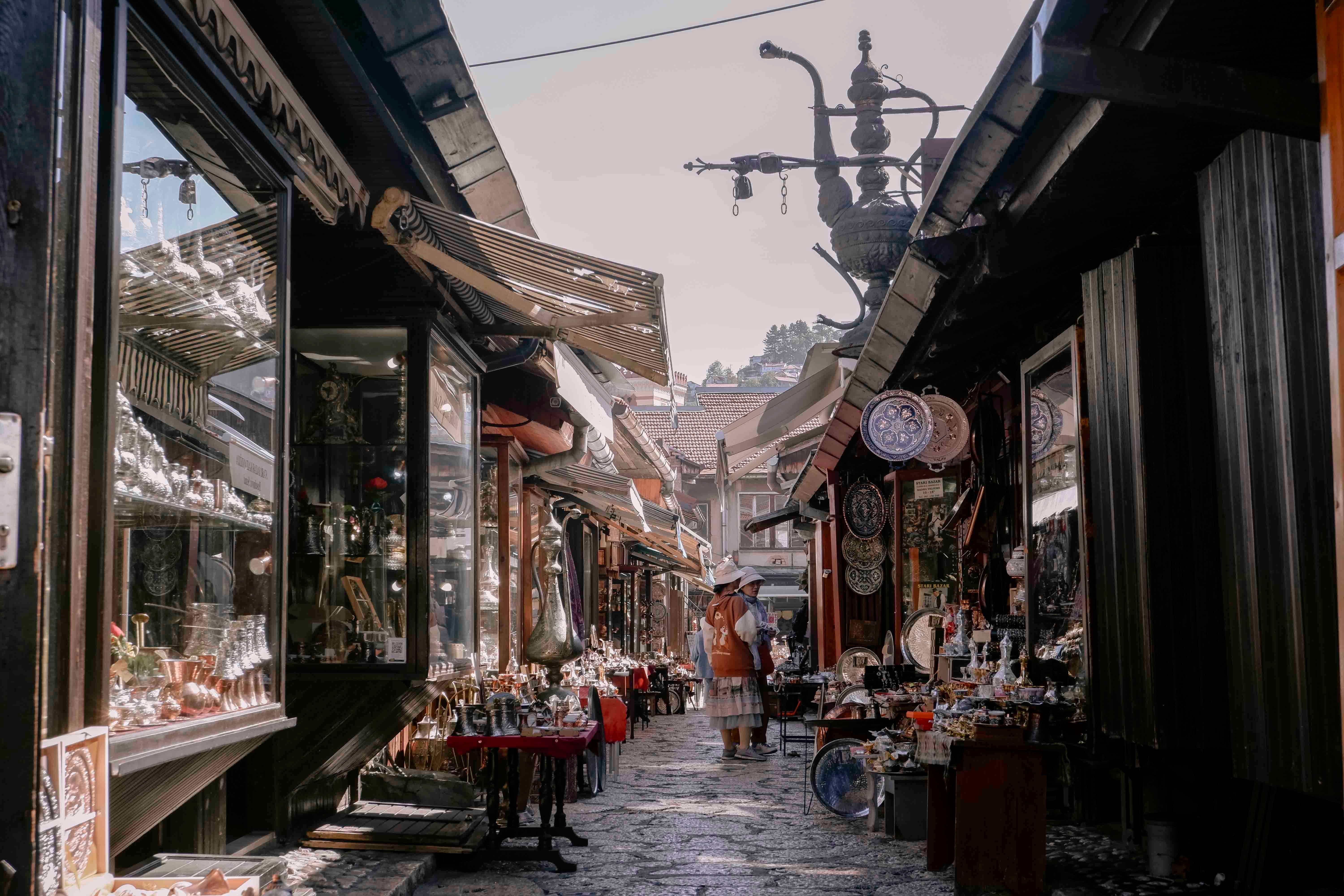
The Sarajevo I experienced was full of life and color. It was the call to prayer echoing through busy market stalls and flaky overstuffed Burek bursting with spinach and cheese. It was people dancing all night long in colorful smoke-filled rooms fueled by adrenaline and rakia shots. This place was alive, it was filled with joy and beauty. It wasn’t stuck in the terror it experienced over thirty years ago.
MORE THAN A MOMENT IN TIME
This is in no way to say Dark Tourism is inherently bad or harmful. More often than not, it is a positive force for education and memory—it teaches us on an emotional level beyond anything we could ever read in a textbook. Rather, it is an invitation for us to think of places as ever-changing and fluid; not singular, stagnant entities.
In practice, a lot of this comes down to spending longer in one location and not ‘checking’ destinations off a speeding pace. It also relies on us to repairing our relationship with travel and connection and how we relate to new places.
So please, keep visiting Dark Tourism locations to learn about history and keep these memory alive.
But, do not let it become your only experience of a place. Do not let it become your single story.
“We live in the flicker . May it last as long as the old earth keeps rolling. But darkness was here yesterday” - a quote from Joseph Conrad that reading this made me think of.
So much of the world’s history is dark, but shouldn’t stop us from living in the current light, embracing the beauty that it is, and marveling at how humanity is repeatedly able to overcome that darkness. That’s something I’m constantly in awe of the more I travel
An insightful piece about Sarajevo and the nuances of dark tourism. We have a saying or whakataukī "Ka mua, ka muri" - Walking backwards into the future. We can't move forward without acknowledging the past and that's what I think Sarajevo does beautifully. I absolutely love Sarajevo. The scars on the building show how they refuse to plaster over their history. The siege happened they acknowledge it, but it doesn't define them.